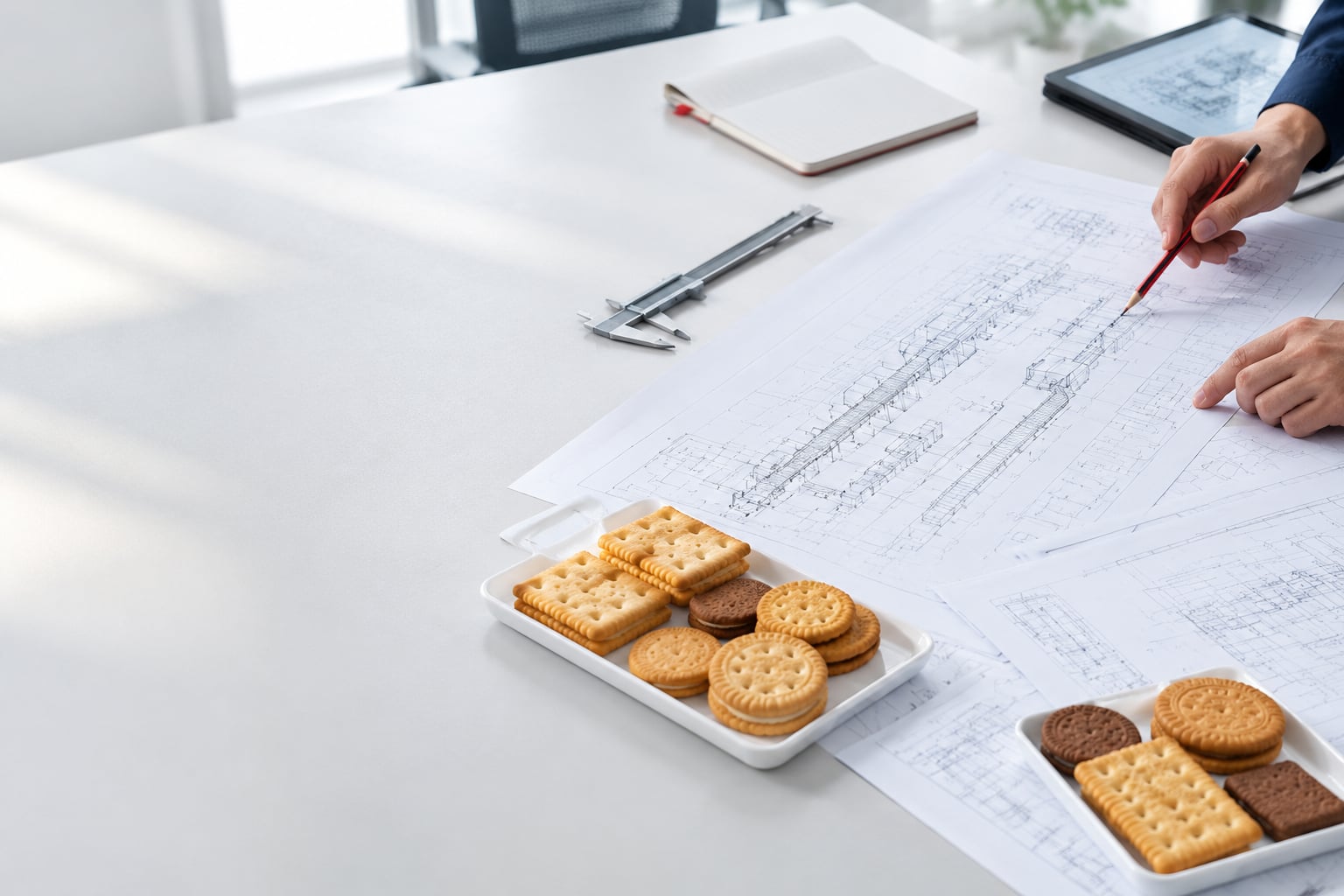
Start with the Product
A tunnel oven should be specified around the biscuit that must leave it. Product thickness, moisture target, surface color, texture and recipe all influence heat transfer and residence time.
A useful supplier discussion starts with representative products and measurable acceptance targets. This gives the engineering team a basis for selecting oven length, belt width, heating method and zone arrangement.
- Product dimensions and piece weight
- Target moisture, color and texture
- Recipe characteristics and forming method
- Required changeover range
Translate Sales Demand into Operating Capacity
Nominal kilograms per hour are only one part of capacity planning. Available production hours, expected efficiency, product changeovers and upstream forming constraints determine the useful output of the complete line.
The oven should be balanced with mixing, forming, cooling and packing. Oversizing one section can increase capital and energy use without increasing packed output.
- Required packed output
- Operating hours and shift pattern
- Expected utilization
- Future product and capacity plans
Compare the Thermal System
Different products need different combinations of radiation, convection and controlled moisture removal. Independent zones allow the baking curve to develop the structure first, then color and dry the product without excessive surface heat.
Ask how temperatures, airflow, exhaust and belt speed are controlled and recorded. The answer should connect directly to the proposed product trials and factory acceptance method.
Review Operation and Lifetime Cost
Energy source, insulation, access doors, cleaning points and component availability affect the oven long after commissioning. A technically suitable oven must also be serviceable by the people who will run it every day.
Before approval, review the full layout around the oven, including burner or heater access, extraction, cooling transfer, emergency routes and maintenance clearance.
- Energy availability and local cost
- Cleaning and inspection access
- Spare-parts strategy
- Safety and maintenance clearances
Wanttone Engineering
Wanttone’s engineering and project teams prepare practical guidance on biscuit machinery, production-line planning and factory requirements.